
.svg)
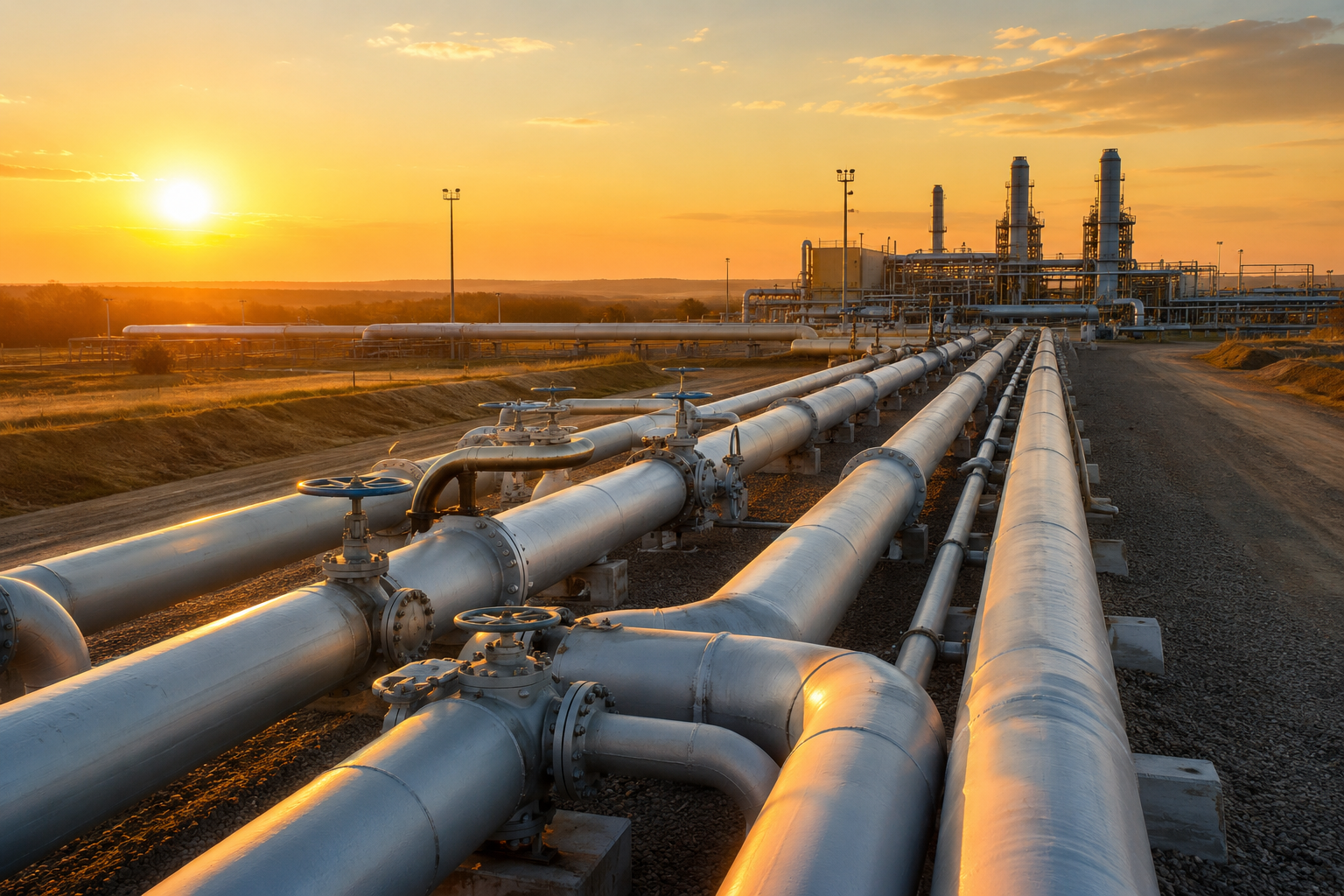
The energy system is entering a new phase of physical growth.
After years of relatively flat electricity demand, the market is now confronting a different reality: rising power needs from data centers, industrial reshoring, manufacturing growth, electrification, LNG expansion, and broader energy-security priorities. This is not only a generation story. It is an infrastructure story.
At Energy Capital Ventures®, we view this as part of the larger energy expansion: the buildout required to support reliable, affordable, and increasingly lower-carbon energy systems. Much of the public conversation focuses on power plants, renewable generation, transmission lines, and LNG export terminals. Those are all important. But the midstream layer may be just as critical.
Pipelines, gathering systems, compression, processing, storage, measurement, and interconnects are the connective tissue of the natural gas value chain. They determine whether molecules can move from where they are produced to where they are needed. They influence reliability, regional pricing, emissions performance, and the ability to serve new load growth.
In this issue of the Green Molecules® Journal, we examine why midstream infrastructure is becoming increasingly strategic in the next phase of energy expansion, and why technologies that improve the performance of this infrastructure may become more valuable as the system scales.
Natural gas is often discussed in terms of supply and demand. How much gas can be produced? How much will power plants, industrial customers, LNG terminals, and global buyers consume?
But between supply and demand sits the midstream system.
That system is what converts resource abundance into usable energy. Without gathering lines, processing plants, compression stations, pipelines, storage assets, and measurement systems, low-cost gas can remain stranded, constrained, or discounted. With the right infrastructure, molecules can move reliably across regions, support power markets, feed industrial demand, and serve export channels.
As energy demand grows, this layer becomes more important.
The United States has abundant natural gas resources, but abundance alone does not solve infrastructure constraints. Gas must be moved out of producing basins, processed to specification, delivered into pipeline networks, and matched with end-use demand. When capacity is constrained, the result can be regional price dislocation, reliability risk, flaring pressure, delayed project development, or underutilized supply.
That is why the midstream opportunity is not simply about building more pipe. It is about building, optimizing, and modernizing the infrastructure that allows the natural gas value chain to function at higher utilization and with greater scrutiny.
As midstream assets become more important, performance becomes more valuable.
Historically, midstream infrastructure has often been viewed through the lens of scale, location, utilization, and contracted cash flow. Those remain essential. But the next phase of the market may place greater value on technologies that improve how infrastructure operates.
Methane management is one example. As more natural gas moves through domestic and global markets, operators face growing expectations around emissions measurement, leak detection, repair prioritization, and supply-chain transparency.
Methane performance is no longer only a sustainability issue. It is increasingly connected to commercial access, regulatory readiness, and buyer confidence.
Compression efficiency is another example. Compression is essential to moving gas through the system, but it also consumes energy and affects operating costs. Technologies that reduce energy loss, improve equipment performance, or recover wasted energy can become more valuable as throughput increases.
Gas processing and separations are also critical. Natural gas, biogas, landfill gas, and other methane-rich streams often contain CO₂, nitrogen, water vapor, hydrogen sulfide, and other impurities. Better separation technologies can improve product quality, reduce energy intensity, and make more distributed resources economically viable.
Digital infrastructure matters as well. The midstream system generates operational data across pressure, flow, composition, equipment status, emissions, and asset integrity. Turning that data into better decisions can improve reliability, reduce downtime, support compliance, and help operators manage increasingly complex networks.
These are not separate themes. They are all part of the same shift: infrastructure performance is becoming a core investment category.
The Green Molecules® thesis is not based on replacing the natural gas value chain overnight. It is based on improving and extending the value of molecule-based infrastructure as the energy system evolves.
Midstream infrastructure is central to that thesis.
Existing gas networks may help enable lower-carbon molecules over time, including renewable natural gas, low-carbon hydrogen, captured carbon streams, and other molecule-based pathways. But compatibility will matter. New technologies must work with real assets, real operating conditions, and real customer requirements.
That creates an advantage for solutions that can plug into the existing system.
Technologies that improve methane measurement, gas upgrading, compression, carbon management, water treatment, asset monitoring, and process efficiency can help the midstream system serve today’s energy demand while preparing for future molecule pathways. They can make existing assets cleaner, more flexible, and more productive without requiring full replacement of the infrastructure base.
This is important because energy expansion and emissions reduction are increasingly linked. The market is not choosing between growth and cleaner systems. It is searching for ways to expand while improving reliability, efficiency, transparency, and carbon intensity.
Midstream is where much of that work becomes practical.
For investors, the midstream opportunity creates several important signals.
First, it reinforces that physical infrastructure remains essential. The energy expansion will require more than software, generation capacity, or end-use demand. It will require the systems that move and manage molecules.
Second, it highlights the value of constraint-solving technologies. When infrastructure is tight, technologies that increase throughput, reduce losses, improve processing, or unlock stranded resources can become more valuable.
Third, it increases the importance of compatibility. Technologies that improve existing assets, integrate into operator workflows, and support near-term economics are likely to be advantaged over solutions that require wholesale system redesign.
Fourth, it shows why emissions performance and infrastructure performance are converging. Methane management, measurement, and efficiency are increasingly part of how the market evaluates reliable energy infrastructure.
For operators, the message is similar. Midstream assets will need to do more: move more molecules, serve more complex demand, operate with greater transparency, and adapt to evolving commercial and regulatory expectations.
That is not only a challenge. It is an opportunity to modernize the infrastructure layer that underpins the natural gas system.
The Energy Expansion is often framed as a question of generation: how much power can be built, how quickly, and at what cost.
That framing is incomplete.
The next phase of energy growth will also depend on deliverability. It will depend on whether molecules can move from production to demand centers reliably, efficiently, and with a credible emissions profile. It will depend on whether infrastructure can scale without becoming a bottleneck. It will depend on whether existing assets can be modernized to meet a more demanding market.
That is the midstream opportunity.
Pipelines, processing, compression, storage, measurement, and controls may not always be the most visible parts of the energy system. But they are becoming some of the most strategic.
For Energy Capital Ventures®, this sits at the center of the Green Molecules® thesis. The future of energy will require reliable molecules. It will also require smarter, cleaner, more efficient systems for moving and managing those molecules.
The Energy Expansion will not be built only at the endpoint.
It will be built across the infrastructure in between.
