
.svg)
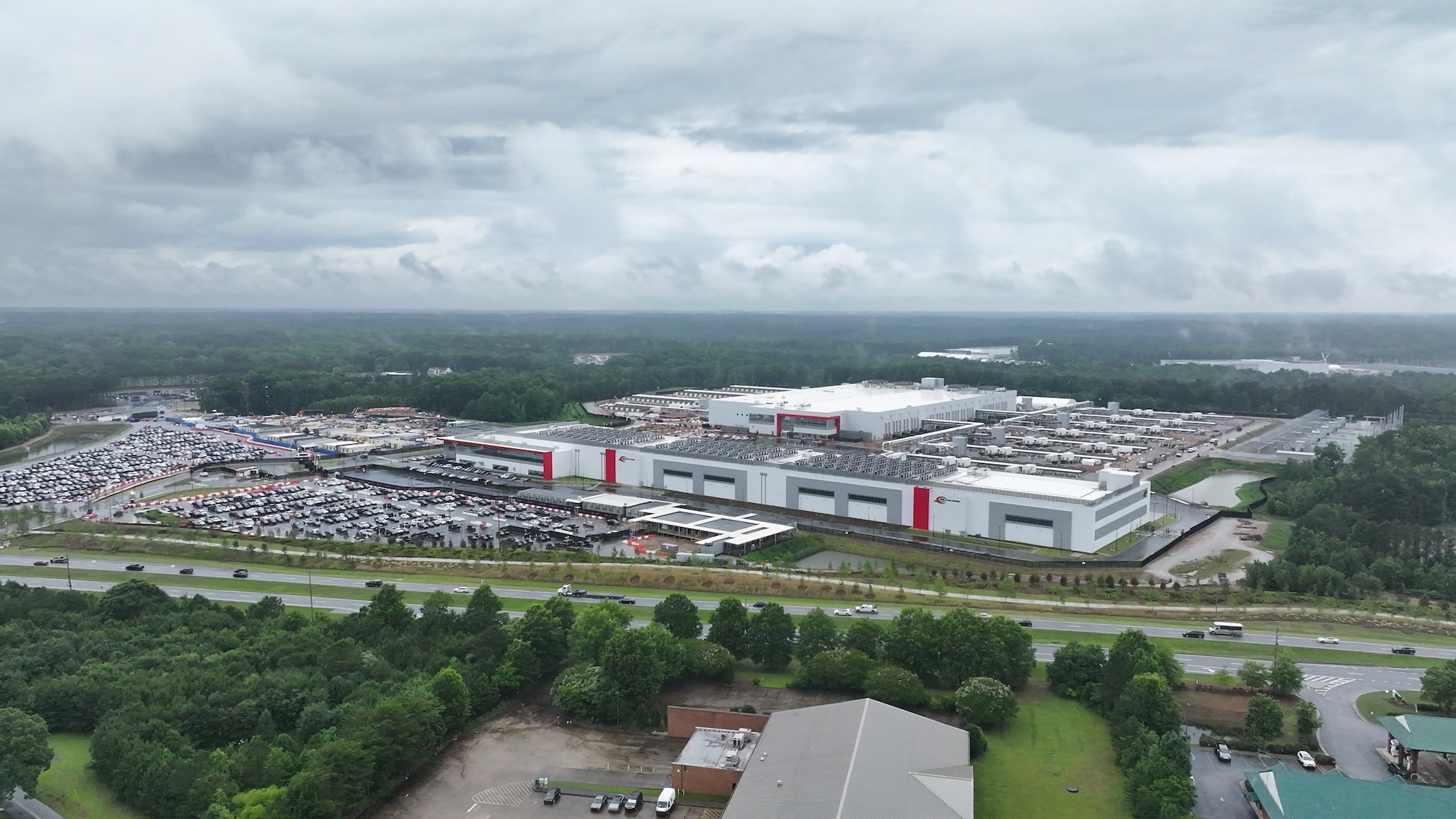
As we laid out in our recent piece, Data Centers, Energy Expansion & Green Molecules®, reliability has become the binding constraint — and the energy system must evolve to keep up. The energy expansion that we at ECV have championed — the buildout required to power AI, reshore manufacturing, and secure America’s competitive position — is facing its first real stress test. Not from technology. Not from capital. From the social license to build.
In this issue of the Green Molecules® Journal, we unpack the forces converging around the data center debate: the grassroots pushback, the moratorium movement, Big Tech’s response, and what capacity markets are telling us about the state of the grid. We close with a few thoughts on where we go from here — because the path forward requires more than just pledges and press releases. For a deeper look at how ECV is investing across this landscape, we invite you to request access to our full 28-page Data Centers, Energy Expansion & Green Molecules® investment thesis.
Over the past twelve months, data center opposition has transformed from scattered local frustration into a coordinated, nationwide movement. More than 230 organizations across all 50 states have called for a national moratorium on data center siting and construction. Communities from Chandler, Arizona to Leesburg, Indiana have blocked or delayed projects. In Q2 2025 alone, data center opponents slowed or stopped projects totaling approximately $100 billion — more than the total of every quarter since 2023.
The grievances are tangible and personal: rising electricity bills, strained water supplies, diesel backup generators polluting neighborhoods, and tax abatements that feel like corporate giveaways at the expense of local schools and infrastructure. In Loudoun County, Virginia (the epicenter of America’s data center industry with over 640 facilities) there are now more than 9,000 diesel generators. In Pennsylvania, ratepayers paid nearly $500 million in 2024 alone for data center-related transmission infrastructure through their monthly bills.
What makes this backlash distinctive is that it cuts across every political and geographic line. Rural communities that welcomed the prospect of economic development are now pushing back alongside suburban and urban residents. State legislators on both sides of the aisle have introduced moratorium legislation, and local officials from Indiana to Arizona have blocked projects outright. The common thread is energy cost: Americans who are already dealing with higher energy costs are unwilling to subsidize trillion-dollar technology companies.
The numbers tell the story. In 2025, more than 200 data center-related bills were introduced across a dozen of states. In just the first six weeks of 2026, that number has already surpassed 300 bills across 30+ states. A significant and growing share of this legislation is focused on moratoriums — temporary pauses on construction to allow state agencies time to study the impacts on utilities, the environment, and local communities.
The movement is accelerating:
• Virginia — the largest data center market in the country — is considering legislation to halt all new data center permit applications until 2028. Lawmakers are also reconsidering the state’s generous tax incentives for data centers, signaling a shift from recruitment to regulation.
• New York has introduced legislation to pause all data center construction for up to three years while the Department of Environmental Conservation and Public Service Commission develop rules to minimize rate impacts on consumers.
• Georgia’s Senate is considering a one-year ban on new data center development starting July 2026.
• Oklahoma has proposed a moratorium on data centers exceeding 100 MW until November 2029 while the state’s public utility commission studies impacts on water supply, utility rates, and property values.
• Maine is actively debating a moratorium on facilities above 20 MW until mid-2028, as data center proposals arrive in a region with some of the highest electricity rates in the nation and an aging electric grid.
• Minnesota, Pennsylvania, South Dakota, and Denver, Colorado have all either enacted or proposed their own pauses in recent weeks.
At least 14 states now have towns or counties that have paused data center permitting. And at least 19 communities in Michigan alone have passed or proposed moratoriums on data center development. This is no longer an isolated phenomenon — it is a structural headwind for the industry.
Critically, the legislative trend is also shifting away from incentives. States that once courted data centers with aggressive tax breaks are now pulling back. Virginia, Georgia, and Oklahoma have proposed reducing or eliminating tax credits. At least 18 states have introduced bills to create special rate classes for large energy users, ensuring data centers pay the full cost of grid connections and infrastructure upgrades rather than socializing those costs across residential ratepayers.
Faced with a growing political crisis, the major hyperscalers have moved quickly to get ahead of the narrative. In rapid succession over recent weeks, the largest AI infrastructure builders have each pledged to absorb the full cost of powering their data centers:
• Microsoft was first, announcing on January 13 its “Community-First AI Infrastructure” initiative. The company pledged to pay the full cost of electricity for its data centers, reject local property tax breaks, replenish more water than it uses, and fund workforce development programs. Microsoft’s President Brad Smith framed it plainly: the sector “worked one way in the past, and needs to work in some different ways going forward.”
• OpenAI followed on January 26, committing that all Stargate campuses will “pay their own way on energy,” either by funding new generation, transmission, and storage infrastructure or covering the incremental grid upgrades their facilities require.
• Anthropic joined on February 11, with CEO Dario Amodei stating that “the costs of powering our models should fall on Anthropic, not everyday Americans.” The company committed to paying 100% of grid infrastructure upgrades and covering consumer electricity price increases in areas where it cannot generate sufficient new power.
Washington has moved to accelerate this shift. During the February 2026 State of the Union address, the President made clear that tech companies have “the obligation to provide for their own power needs.” That message culminated on a White House event that will host executives from Amazon, Google, Meta, Microsoft, xAI, Oracle, and OpenAI on March 4th to sign the “Ratepayer Protection Pledge,” a formal commitment to “build, bring, or buy” their own power supply for new AI data centers. The signing represents the most significant public-private alignment on data center energy policy to date: seven of the largest AI infrastructure builders, standing alongside the President, committing on the record that American ratepayers will not subsidize the AI buildout. It is a notable signal that the federal government is serious about enabling American AI leadership while protecting consumers and communities.
These commitments are meaningful and directionally correct. But they raise as many questions as they answer. What does “covering the full cost” actually mean in practice? Who determines causation when electricity prices rise in a region with multiple demand drivers? How do voluntary pledges interact with rate-regulated utility structures? And perhaps most importantly: pledges from individual companies, however well-intentioned, do not solve the systemic infrastructure deficit that is the root cause of the problem.
As Anthropic itself acknowledged: “Company-level action isn’t enough. Keeping electricity affordable requires systemic change.”
If the moratorium movement is the political signal, capacity markets are the economic one. And the message from both PJM and MISO is unambiguous: the grid is running out of headroom.
PJM Interconnection, the grid operator serving 67 million people across 13 states and the District of Columbia, has seen three consecutive record-setting capacity auctions:
• The 2025/2026 auction saw prices surge roughly 900%, from approximately $29/MW-day to $270/MW-day.
• The 2026/2027 auction cleared at $329/MW-day, another 22% increase and the highest on record.
• The December 2025 auction for 2027/2028 hit the $333.44/MW-day price cap and still came up 6,623 MW short of the reliability requirement. For the first time, PJM could not procure enough capacity at any price within its allowed range.
The driver is clear: demand is growing far faster than supply. Nearly 5,100 MW of the 5,250 MW increase in PJM’s latest demand forecast is attributable to data centers. Meanwhile, coal and gas plant retirements continue, the interconnection queue remains severely backlogged, and new generation projects face years of permitting and construction timelines. Governors from nine states have written to PJM expressing deep concern about grid reliability and rising costs.
MISO tells a parallel story. Summer capacity prices for 2025/2026 reached $666.50/MW-day (up 2,100% from the year prior!) under the grid operator’s new Reliability-Based Demand Curve. The summer surplus has fallen from 6.5 GW in 2023 to 4.6 GW in 2024 and just 2.6 GW in 2025 — a 60% decline in two years. The market is uncomfortably close to its planning reserve margin target, with declining retirements, rising peak loads, and slower-than-expected capacity additions tightening the system.
The implications are cascading. Since June 2025, utility supply rates across the PJM region have increased between 5% and 44%. Capacity costs from these auctions will be baked into electric rates for years. Some areas of Maryland face potential bill increases of up to 24%. Businesses face higher fixed costs that squeeze margins and weaken competitiveness. Manufacturers factor those costs into decisions about where to invest — or whether to invest at all.
This is the paradox at the heart of the energy expansion: the very infrastructure needed to power AI and advanced manufacturing is also driving up the cost of energy for the communities and industries that are supposed to benefit from it.
The policy environment is working to catch up. State legislatures are introducing moratoriums and rate protections as they grapple with a buildout that has moved faster than anyone anticipated. At the federal level, FERC unanimously ordered PJM in December 2025 to overhaul its rules for co-located and behind-the-meter large loads, finding that existing rules violated cost-causation principles by allowing data centers to reduce transmission charges in ways that shifted costs to other ratepayers. The Department of Energy has urged FERC to expand its jurisdiction over large-load interconnections, citing “unprecedented electricity demand.” These are welcome and necessary steps.
But the pace of regulation is fundamentally mismatched with the pace of buildout. By the time FERC acts on its proposed rulemaking (expected by April 2026) billions more in data center investment will have been committed. By the time state moratoriums take effect, projects already in the pipeline may be grandfathered. And by the time new generation is built to serve these loads, the demand forecast will likely have shifted again.
The Ratepayer Protection Pledge is an important step and the right instinct. But voluntary commitments alone will not close the infrastructure gap. What is ultimately needed is a durable regulatory framework that addresses interconnection reform, cost allocation, permitting acceleration, and grid investment in a coordinated way. The good news is that the pieces are coming together: federal permitting reform, FERC action on cost-causation, and executive focus on unleashing domestic energy production all point in the right direction. The question is speed of execution.
At Energy Capital Ventures®, our core thesis has always been that the world’s growing energy demand requires an energy expansion, not an energy transition. That thesis has never been more relevant or more tested. The forces now converging around data centers expose the central tension of this moment: we need to build an enormous amount of energy infrastructure, quickly, but the systems designed to plan, permit, and pay for that infrastructure were not built for this pace or this scale.
Here are a few things we believe:
The energy expansion is necessary and non-negotiable. The AI race, the reshoring of advanced manufacturing, and the modernization of America’s industrial base all require enormous new power capacity. The Lawrence Berkeley National Lab estimates that data centers could consume 12% of all U.S. electricity by 2028, up from 4.4% in 2024. The International Energy Agency projects U.S. data center electricity consumption could triple by 2035. These are not optional loads. They are the foundation of economic competitiveness. But this expansion cannot come at the expense of affordability and reliability for the households and businesses that depend on the existing grid.
The grid is a bottleneck, not a barrier. The problem is not that the grid cannot be expanded; it’s that the timelines for doing so are fundamentally misaligned with the timelines for demand growth. Transmission projects take 7–10 years from inception to energization. Interconnection queues in PJM and MISO are backed up with tens of thousands of megawatts of capacity that has been approved but not yet built. Permitting reform, at both the federal and state level, is the single most impactful lever available to policymakers. Federal efforts to accelerate permitting and cut regulatory red tape are exactly the right approach, and the energy industry should be doing everything it can to support and accelerate those efforts.
Natural gas and Green Molecules® are essential to the energy expansion. Renewables and nuclear will be critical to the long-term energy mix, but they cannot scale fast enough on their own to meet the near-term demand surge. Natural gas-fired generation remains the most rapidly deployable, reliable source of new baseload capacity. On-site gas turbines, microturbines, engines, fuel cells, and behind-the-meter modular gas solutions are already being deployed at data centers as a practical response to grid constraints. At the same time, innovations in Green Molecules®, from renewable natural gas to carbon capture, are creating pathways to decarbonize gas-powered infrastructure without sacrificing reliability or speed. This is the core of ECV’s investment focus.
Cost socialization must end, but cost clarity must come first. The principle that data centers should pay their own way is correct and rapidly becoming consensus. But operationalizing it requires more than voluntary corporate pledges. It requires rate design reform, special large-load tariffs, and clear rules for cost allocation that are enforceable by state utility commissions. The patchwork of 300+ state bills currently in play is evidence that no one has yet found the right framework. Getting this wrong, by either over-burdening consumers or over-deterring investment, carries enormous economic consequences.
Speed matters more than perfection. The pace of data center buildout is outrunning the pace of regulatory adaptation. By the time moratoriums are enacted, the projects they target may already be in the ground. By the time FERC completes its rulemaking, the market will have moved. This creates a risk: communities feel unprotected, so they demand blunt instruments like moratoriums; the industry feels threatened, so it seeks pre-emption; and the result is a fragmented landscape where neither side gets what it needs. The best antidote is proactive engagement, from the industry, from utilities, and from policymakers, that creates clear, predictable rules of the road before the next wave of projects arrives. Federal efforts to streamline permitting and the Ratepayer Protection Pledge are both steps in the right direction.
The companies that get community engagement right will win. The moratorium movement is, at its core, a failure of process, not a rejection of progress. Communities are not opposed to economic development. They are opposed to having trillion-dollar companies extract value from their land, water, and power systems without meaningful local benefit. The hyperscalers that invest early in genuine community partnerships, transparent benefit-sharing, and workforce development will find willing hosts. Those that rely on corporate lobbying and payment-in-lieu-of-taxes schemes will face continued resistance. Microsoft’s experience in Wisconsin, where initial enthusiasm turned to opposition in the span of months, is instructive. The window for social license is smaller than anyone expected.
The energy expansion is coming. It is both inevitable and essential. But it will not happen on autopilot. The path forward requires balancing competing priorities: speed versus sustainability, national competitiveness versus local affordability, corporate ambition versus community consent. It requires a grid that can grow fast enough, a policy framework that can adapt fast enough, and an energy system that can deliver clean, reliable, cost-effective power at a scale we have never attempted before.
That is the challenge Green Molecules® were designed to address.
