
.svg)
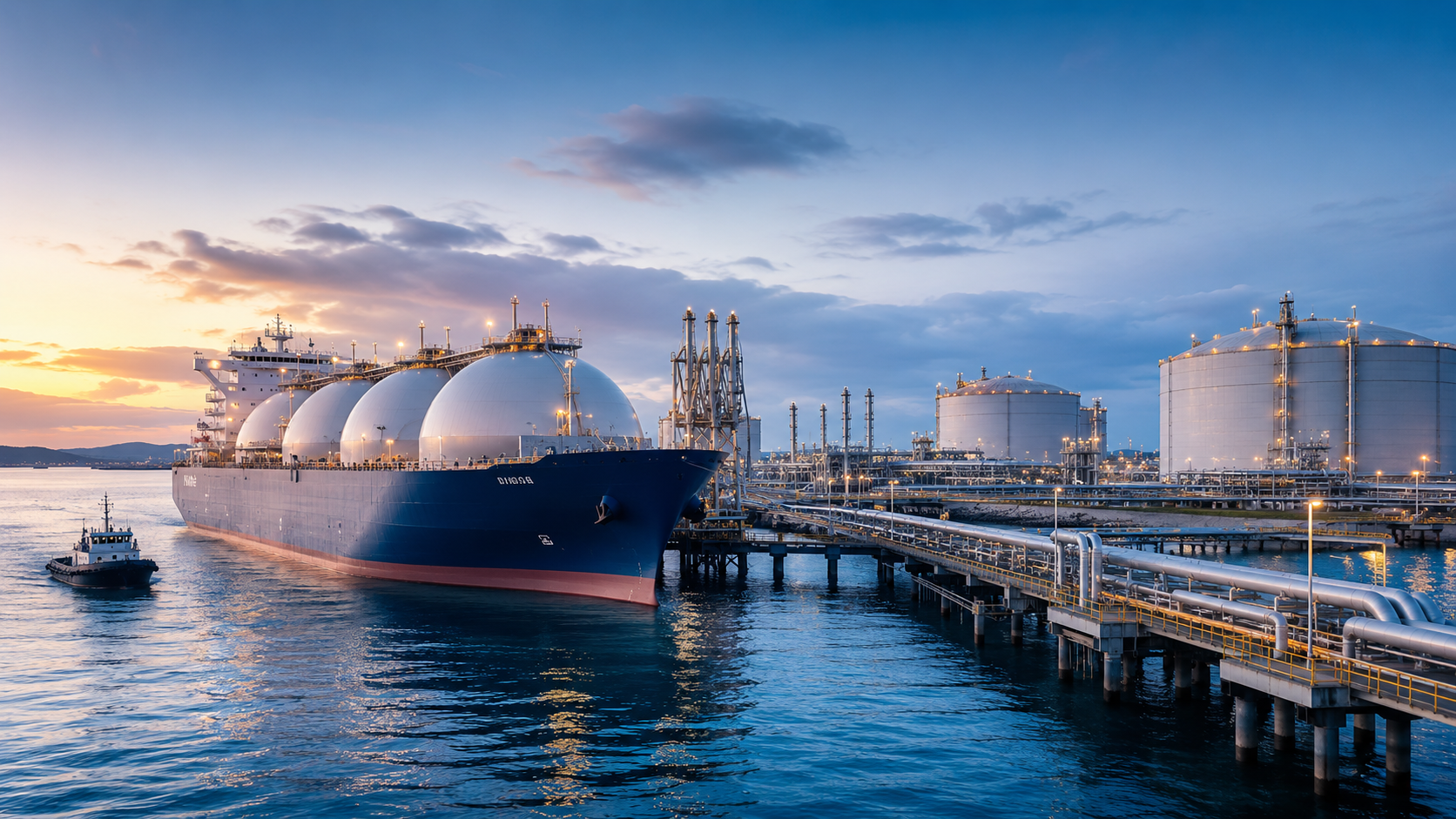
The LNG market is entering a more complex expansion cycle. Global demand for reliable, transportable energy remains strong, while geopolitical disruptions, shifting trade flows, and price volatility are reinforcing the strategic importance of flexible gas supply. At the same time, this is not a simple growth story. LNG markets are being shaped by competing forces: energy security, affordability, infrastructure constraints, emissions scrutiny, and the need for long-term supply reliability.
LNG is often discussed as an export story — a question of how much U.S. gas can be shipped abroad and which countries will buy it. But the implications are broader than that.
At Energy Capital Ventures®, we view LNG expansion as part of a larger Energy Expansion: the infrastructure buildout required to support rising global energy demand, industrial growth, AI-driven power needs, and the continued importance of reliable, transportable molecules. LNG is not just a commodity export. It is a signal that the natural gas value chain is entering a new infrastructure cycle.
That cycle will require more than liquefaction terminals. It will require upstream production, gathering systems, pipelines, compression, gas processing, methane management, power supply, carbon management, water infrastructure, measurement systems, and technologies that improve the efficiency and carbon profile of the gas system itself.
This is where the Green Molecules® thesis becomes increasingly relevant. The next phase of LNG expansion highlights why the natural gas value chain must become more efficient, more transparent, and lower carbon-intensity as it scales. The question is not whether LNG demand creates infrastructure needs. It clearly does. The more important question is what kind of infrastructure gets built — and which technologies help that infrastructure expand responsibly.
In this issue of the Green Molecules® Journal, we examine LNG expansion not simply as a trade flow story, but as a platform for the next wave of investment across natural gas and Green Molecules® innovation.
The United States has become one of the central suppliers in global LNG markets, supported by abundant domestic gas production, Gulf Coast infrastructure, and a growing base of long-term offtake agreements. As new export terminals and expansions ramp, the LNG market is moving into a period where supply growth is less theoretical and more physical: projects are moving from permitting and construction into commissioning and operations.
That shift matters because LNG export growth does not occur in isolation. Every incremental molecule exported as LNG must first move through a much larger system. It must be produced, gathered, processed, transported, compressed, liquefied, stored, loaded, shipped, regasified, and ultimately consumed. Each step creates infrastructure demand. Each step introduces operational complexity. Each step creates opportunities for efficiency, measurement, and emissions reduction.
In that sense, LNG expansion is not just about export terminals. It is about the full natural gas value chain.
The most visible infrastructure sits at the coast: liquefaction trains, storage tanks, marine terminals, and related power systems. But the less visible infrastructure may be equally important. Additional LNG demand can increase the need for pipeline takeaway capacity from producing basins, particularly regions like the Haynesville and Permian that are strategically located relative to Gulf Coast export demand. It can increase the value of gas processing, dehydration, compression, and measurement systems. It can also increase the importance of methane performance across upstream and midstream operations, because buyers are increasingly focused not only on supply reliability, but on the emissions profile of the gas they purchase.
This is why LNG expansion should be understood as a catalyst for broader infrastructure modernization. The export terminal may be the endpoint, but the value chain behind it is where much of the next investment cycle will unfold.
The global economy is demanding more energy, not less. Data centers, industrial reshoring, manufacturing growth, electrification, and rising energy demand in emerging markets are all increasing the need for reliable energy systems. In this environment, molecules remain essential because they provide capabilities that electricity alone cannot easily replicate at scale: storage, transportability, dispatchability, and compatibility with existing industrial systems.
LNG sits directly within that logic.
Unlike electrons, LNG can move across oceans. It can be redirected based on market need. It can serve countries without sufficient domestic gas supply. It can backstop power systems, support industrial demand, and displace higher-emitting fuels in certain markets. It is not the only answer to global energy demand, but it is one of the few energy carriers capable of moving large volumes of reliable energy across continents.
That flexibility has become more valuable as energy markets have become more volatile. Global buyers increasingly care not only about price, but about certainty of delivery, jurisdictional stability, contract structure, and supply-chain resilience. LNG offers a mechanism for connecting supply-rich regions with demand centers that need reliable molecules but lack sufficient domestic resources.
This does not eliminate the need to manage emissions. In fact, it raises the bar.
As LNG becomes more important to global energy security, the carbon intensity and methane profile of the gas system will receive more scrutiny. Expansion will increasingly require credible measurement, lower-emission operations, carbon management, and technologies that improve the efficiency of infrastructure already in place.
That is the core opportunity for Green Molecules® within the LNG cycle: helping the natural gas system scale while improving the way it operates.
As LNG volumes grow, the natural gas value chain will face greater pressure to operate efficiently, reliably, and with increasing transparency. That does not mean every market will prioritize the same emissions or carbon-management strategies.
Buyer expectations, regulatory requirements, infrastructure constraints, and regional economics will vary significantly. But across the system, higher gas throughput increases the value of technologies that improve performance across production, processing, movement, and measurement.
Methane management is one example. As more gas moves into export markets, operators and buyers will continue to pay closer attention to methane intensity, measurement quality, and supply-chain transparency. This is not only a compliance issue; in certain markets, it may increasingly affect commercial access, procurement decisions, and counterparty preference. Technologies that help operators detect, quantify, verify, and reduce emissions can become part of the infrastructure layer supporting a more credible and efficient gas system.
Gas upgrading and separations are another important piece. Natural gas, biogas, landfill gas, and other methane-rich streams often require processing before they can meet pipeline or end-use specifications. As demand grows, efficient treatment of CO₂, nitrogen, water vapor, hydrogen sulfide, and other impurities becomes more important to both system economics and resource utilization. Better separations can reduce energy consumption, improve product quality, and make more distributed methane resources economically usable.
Carbon management also remains relevant, though its importance will depend heavily on site-specific economics, policy structures, and proximity to transport or storage infrastructure. LNG facilities, gas processing plants, industrial customers, and power assets may all evaluate carbon capture or utilization differently. In some cases, large-scale infrastructure will make sense; in others, modular or distributed approaches may be more practical. The broader point is not that every LNG-linked asset will adopt the same carbon strategy, but that emissions management will increasingly be considered alongside reliability, cost, and infrastructure planning.
This is where Green Molecules® innovation fits naturally. Companies focused on methane measurement, gas upgrading, distributed carbon capture, water-linked carbon removal, and process efficiency are not separate from the LNG story. They are part of how the natural gas value chain becomes more resilient and investable as it expands. For Energy Capital Ventures®, the opportunity lies in technologies that improve the performance of existing and future infrastructure without assuming a one-size-fits-all pathway across every market.
For investors, LNG expansion creates several important signals.
First, it reinforces that natural gas infrastructure remains investable. Global demand for reliable molecules continues to support long-term investment in production, pipelines, processing, liquefaction, shipping, and storage.
Second, it raises the value of technologies that improve the existing gas system. Methane measurement, gas upgrading, compression efficiency, carbon management, water recovery, distributed capture, and energy optimization all become more relevant as gas volumes grow.
Third, it highlights the importance of infrastructure compatibility. Technologies that plug into existing assets, improve operating performance, or reduce emissions without requiring full system replacement are likely to be advantaged.
Fourth, it demonstrates that energy growth and emissions management are increasingly linked. The market is not choosing between expansion and cleaner systems. It is looking for ways to expand while improving the carbon intensity, efficiency, and resilience of the infrastructure being built.
That is precisely where Green Molecules® fit.
They are not a replacement for the natural gas value chain. They are part of how the natural gas value chain evolves.
LNG expansion is often framed as a response to global demand. That is true, but incomplete.
It is also a catalyst for the next infrastructure cycle across the natural gas value chain.
More LNG exports require more production, more pipelines, more processing, more power, more measurement, more carbon management, and more operational efficiency. That creates both challenges and opportunities.
The challenge is clear: the natural gas system must scale in a world where emissions scrutiny, infrastructure constraints, and reliability expectations are all increasing.
The opportunity is equally clear: technologies that help the gas system expand responsibly are becoming more valuable.
For Energy Capital Ventures®, this is at the core of the Green Molecules® thesis. The energy expansion will require reliable molecules, but it will also require cleaner, smarter, more efficient systems for producing, moving, measuring, and managing those molecules.
LNG is not just an export story.
It is a signal that the next infrastructure cycle has already begun.
